Book a free 1:1 session to find your ideal course


Agile Courses Offered By Skillcubator


Artificial Intelligence Courses Offered By Skillcubator

Business Analysis Courses Offered By Skillcubator


Business Process Courses Offered By Skillcubator


Certifications Courses Offered By Skillcubator

Cloud Computing Courses Offered By Skillcubator
CyberSecurity Courses Offered By Skillcubator

Data Courses Offered By Skillcubator

Product Management Courses Offered By Skillcubator

Project Management Courses Offered By Skillcubator

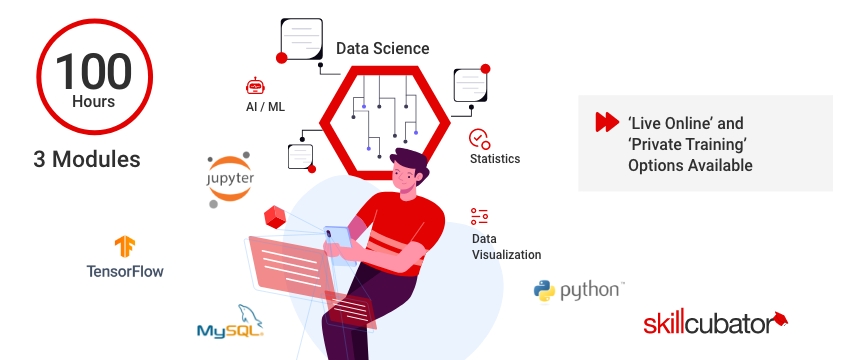
The Data Science Program at Skillcubator is a comprehensive training course designed to equip learners with in-demand skills in data analysis, machine learning, and artificial intelligence. It focuses on preparing learners for jobs in the data field.
Through hands-on projects, real-world case studies, and industry-relevant tools such as Python, SQL, and Power BI, learners gain practical experience to solve business problems and make data-driven decisions. This program is ideal for professionals looking to transition into high-growth data science roles.
This program is ideal for:
- Working professionals looking to transition into high-demand data science roles.
- Non-technical individuals who want to build a career in data without prior coding experience.
- Recent graduates or students aiming to enter data science field .
- Business Analysts, IT professionals, or Project Managers looking to upskill with advanced data-driven decision-making.
- Career switchers from domains like finance, marketing, operations etc.
- Anyone interested in AI, Machine Learning, and data-driven problem-solving.
- Entrepreneurs wanting data-driven decisions.
- Product Managers seeking data literacy.
- Data Analysts advancing to data science field.
- Data Scientist.
- ML Engineer.
- Business Intelligence Analyst.
- Data Analyst.
- Reporting Analyst.
- Analytics Consultant.
Foundations & Business Context
Data Science & Business: The Big Picture
- What is Data Science and AI?
- Data Science roles: Analyst, Scientist, Engineer.
- Business use cases: Finance, Marketing, HR, Supply Chain.
- Data Science lifecycle: Problem → Insight → Action.
- Understanding data types: structured vs unstructured.
Excel & SQL for Business Data
- Advanced Excel: VLOOKUP, INDEX-MATCH, Pivot Tables, Power Query.
- SQL basics: SELECT, WHERE, GROUP BY, ORDER BY, JOIN (INNER/LEFT/RIGHT).
- Database concepts: tables, primary keys, foreign keys.
- Writing business queries on real datasets.
- Connecting SQL to Excel.
- Introduction to Google BigQuery.
Python Programming for Non-Programmers
- Python setup (Anaconda, Jupyter Notebook, VS Code).
- Variables, data types, operators.
- Control flow: if-else, loops.
- Functions and modules.
- Lists, dictionaries, tuples, sets.
- File handling and basic I/O.
- Exception handling basics.
Statistics & Mathematics Essentials
- Descriptive statistics: mean, median, mode, variance, std dev.
- Probability fundamentals and distributions (Normal, Binomial, Poisson).
- Hypothesis testing: t-test, chi-square, ANOVA.
- Correlation vs causation.
- Confidence intervals and p-values.
- Introduction to linear algebra (vectors, matrices) for ML context.
Data Thinking & Business Problem Framing
- CRISP-DM methodology.
- How to frame a data science problem from a business requirement.
- KPI definition and success metrics.
- Data sources: internal (CRM, ERP) vs external (APIs, web).
- Ethical considerations in data science.
- Introduction to GDPR and data privacy concepts.
Data Engineering & Analysis
Advanced Python — NumPy & Pandas
- NumPy arrays, broadcasting, vectorized operations.
- Pandas Series and Data Frames in depth.
- Data import: CSV, Excel, JSON, APIs, Databases.
- Data cleaning: nulls, duplicates, type conversion.
- Merging, joining, reshaping data (melt, pivot).
- GroupBy, aggregations, apply/lambda.
- Time-series indexing and resampling.
Exploratory Data Analysis (EDA)
- Matplotlib: figures, axes, subplots.
- Seaborn: statistical plots (heatmap, pairplot, regplot).
- Plotly: interactive charts for business dashboards.
- Choosing the right chart for the right story.
- Color theory and visual design principles.
- Geospatial visualization basics (Folium).
- Exporting publication-ready visuals.
Business Intelligence — Power BI & Tableau
- Power BI: data modeling, DAX basics, report building.
- Tableau: connecting to data, creating dashboards.
- Calculated fields, parameters, filters.
- KPI cards, trend charts, geographical maps.
- Publishing and sharing dashboards.
- Connecting live data sources.
- Best practices for executive dashboards.
Advanced SQL & Database Engineering
- Window functions: RANK, DENSE_RANK, ROW_NUMBER, LAG, LEAD.
- Common Table Expressions (CTEs) and recursive queries.
- Subqueries and query optimization.
- Stored procedures and views.
- Data warehousing concepts: OLAP vs OLTP, Star vs Snowflake schema.
- Introduction to NoSQL: MongoDB basics for unstructured data.
- Cloud databases: AWS RDS, Google BigQuery hands-on.
Feature Engineering & Data Preprocessing
- Encoding categorical variables: one-hot, label, target encoding.
- Handling class imbalance: SMOTE, oversampling.
- Scaling & normalization: MinMax, StandardScaler, RobustScaler.
- Binning, log transforms, polynomial features.
- Text feature extraction: TF-IDF basics.
- Date/time feature engineering.
- Feature selection methods: filter, wrapper, embedded.
Machine Learning
Machine Learning (ML) Foundations
- Types of ML: supervised, unsupervised, semi-supervised, reinforcement.
- Bias-variance tradeoff.
- Training, validation, test splits; cross-validation (K-Fold, Stratified).
- Overfitting, underfitting, regularization (L1/L2).
- Scikit-learn pipeline: fit, transform, predict.
- Evaluation metrics: accuracy, precision, recall, F1, ROC-AUC, RMSE, MAE.
- Grid Search & RandomizedSearchCV for hyperparameter tuning.
Regression Algorithms
- Linear Regression: OLS, gradient descent from scratch.
- Multiple Linear Regression and multicollinearity (VIF).
- Polynomial Regression.
- Ridge, Lasso, ElasticNet regularization.
- Decision Tree Regressor.
- Random Forest Regressor.
- Gradient Boosting for regression (XGBoost, LightGBM).
Classification Algorithms
- Logistic Regression: odds ratio, sigmoid, interpretation.
- k-Nearest Neighbors (KNN).
- Naive Bayes (Gaussian, Multinomial).
- Support Vector Machines (SVM) with kernels.
- Decision Tree Classifier & pruning.
- Random Forest Classifier, feature importance.
- Gradient Boosting: XGBoost, LightGBM, CatBoost.
Ensemble Methods & Advanced Boosting
- Bagging vs Boosting vs Stacking.
- Random Forest deep dive: feature importance, OOB error.
- AdaBoost mechanics.
- XGBoost: tree parameters, regularization, early stopping.
- LightGBM: leaf-wise growth, categorical features.
- CatBoost for business tabular data.
- Model blending and stacking ensembles.
- Handling imbalanced datasets in classification.
Unsupervised Learning
- K-Means Clustering: elbow method, silhouette score.
- Hierarchical Clustering: dendrograms.
- DBSCAN for density-based clustering.
- Gaussian Mixture Models.
- Principal Component Analysis (PCA) for dimensionality reduction.
- t-SNE and UMAP for visualization.
- Association Rule Mining: Apriori, FP-Growth (market basket analysis).
Model Interpretability & Business Communication
- Why interpretability matters in business.
- SHAP values: global and local explanations.
- LIME for local model explanation.
- Partial Dependence Plots (PDP) and ICE plots.
- Feature importance for tree-based models.
- Model cards and responsible AI documentation.
- Translating model outputs into business recommendations.
Recommendation Systems
- Collaborative filtering: user-based & item-based.
- Content-based filtering.
- Matrix factorization (SVD).
- Hybrid recommendation systems.
- Evaluation: RMSE, precision@k, MAP.
- Cold start problem and solutions.
- Business applications: e-commerce, streaming, cross-sell.
Time Series Analysis & Forecasting
- Time series decomposition: trend, seasonality, residuals.
- Stationarity testing: ADF test.
- ARIMA and SARIMA models.
- Exponential Smoothing (Holt-Winters).
- Facebook Prophet for business forecasting.
- Machine learning for time series (XGBoost with lag features).
- Cross-validation strategies for time series.
- Data Science.
- Data Mining.
- Data Engineering.
- Database Management.
- Structured Query Language (SQL).
- Story Telling Through Data.
- Inferential Statistics.
- Machine Learning.
- Data Analysis.
- Prompt Engineering.
- Exploratory Data Analysis.
- Core Python Programming.
- Model Building and Finetuning.
- Deep Learning Frameworks.
- Generative AI and LLMs.
- Descriptive Analytics.
- Conversational AI.
- MLOps.
- Data Manipulation and Analysis.
- Large Language Models.
- Data Visualization.
- Hypothesis Testing.
- Supervise and Unsupervised Learning.
- Job-Ready Curriculum: Industry-aligned, future-focused curriculum built to prepare learners for evolving job market demands.
- Career Guidance: Expert counselors for personized counselling for career advancement and transition opportunities.
- Latest Data Science Tools: Build hands-on expertise with leading data science tools/software, ML frameworks and AI- powered tools. Learn tools like MySQL, Jupyter, Python, Power BI, TensorFlow, Pandas, NumPy, Matplotlib and more.
- AI-Powered: Leverage artificial intelligence (AI) using no-code platforms to perform data analysis.
- 100% Live Interactive Learning: Live online interactive sessions led by industry experts in the field of data science (PhDs, IIT/NIT/IIM alumni with 15-plus years of industry experience).
- Hands-On Projects: Build real-world skills through 10+ course-end projects.
- Capstone Project: Demonstrate your skills through a capstone project for holistic learning.
- Portfolio: Create a job-ready portfolio to share it with your prospective employer.
- 24*7 Support: Resolve doubts in real-time.
- Learning Aids: Plenty of online quizzes, break-out sessions, and in-class exercises during the live sessions.
- Flexible Payment Plans: Affordable and convenient payment plans available.
- Lifetime Access: Get lifetime access to recorded sessions and learning resources.
- Resume and LinkedIn: Receive a personalized resume and LinkedIn optimization.
- Career Support: Benefit from Skillcubator’s career support services. Free placement and unlimited post-placement support.
- Microsoft Excel.
- MySQL.
- Jupyter.
- Python.
- Power BI.
- TensorFlow.
- Pandas.
- NumPy.
- Matplotlib.
- Keras.
- Seaborn.
- SciPy.
- ChatGPT.
Data Science involves deriving insights from data gathered through various methods. The process includes defining the problem by performing exploratory data analysis, applying different algorithms to model the data, and presenting the findings through visual tools like graphs and dashboards.
This program is ideal for anyone—whether working professionals, recent graduates, or current students—looking to upskill or reskill in Data Science. No prior technical background or coding experience is necessary.
The data industry is rapidly expanding, with the data science market projected to reach a value of $322.9 billion by 2026, growing at a compound annual growth rate (CAGR) of 27.7% since 2021. The demand for data scientists continues to rise, as the US Bureau of Labor Statistics estimates a remarkable 35% employment growth between 2022 and 2032, highlighting the increasing need for skilled professionals capable of analyzing data and extracting valuable insights. Beyond strong demand, a career in data science offers attractive benefits, including enhanced job security, a wide array of opportunities, and generally higher salaries.
This program transforms learners into invaluable assets in the data-driven economy by equipping them with highly sought-after skills.
- Participants acquire a comprehensive skill set in Python, SQL, machine learning, and Generative AI, equipping them for a wide range of roles in data science.
- Through hands-on projects and a real-world capstone project, learners develop a strong portfolio that demonstrates their practical skills to potential employers.
- The program offers career support services including resume building, LinkedIn profile enhancement, and interview preparation to help trainees effectively showcase their abilities and attract leading employers.
- Emphasizing the latest trends such as Generative AI and prompt engineering, the program prepares trainees to innovate and lead in the rapidly evolving data science landscape.
A data analyst interprets past data, a data scientist forecasts future outcomes, and a machine learning engineer implements those predictions for real-time applications. These roles represent different stages of the data life cycle and require unique skill sets:
- A Data Analyst analyzes large datasets to identify trends, generate reports, and create visualizations that answer specific business questions. Their work is primarily descriptive, focusing on past events
- A Data Scientist handles more complex and unstructured data, applying advanced statistical techniques and machine learning to develop predictive models and address broader questions about the future.
- A Machine Learning Engineer is a specialized software engineer responsible for deploying models created by data scientists into production environments, enabling their use in scalable applications.
In simple terms, a data analyst describes what has happened, a data scientist predicts what will happen, and a machine learning engineer makes these predictions actionable in real time.
Data Scientists gather, process, and analyze data from various sources. They develop predictive models and interpret the data to extract valuable insights. These insights are then shared with business teams to support informed decision-making.
Python is the most widely used and preferred language for developing data science applications due to its simplicity and open-source nature. In addition to Python, data scientists also commonly use R and SQL.
No. However, we expect you to possess basic computing skills, solid logical and analytical thinking, and, most importantly, a strong willingness to learn new concepts, software, and programming languages such as Python and SQL. Essentially, you should approach this program with an open mind and readiness to embrace technical concepts. We will prepare you to be job-ready within 4 months.
We follow a rigorous vetting process to select top industry talent. Our trainers come from exceptional academic backgrounds (IIT/IIM alumni, PhD holders) and bring over 15 years of corporate experience. You can be confident that you will receive a high-quality, top-tier learning experience.
The career path for a data scientist is not strictly linear and can branch in many directions, but it typically progresses from junior roles focused on technical execution to senior roles involving strategy, leadership, and complex problem-solving. Career growth often depends on a combination of technical skills, business acumen, and leadership capabilities.
- Entry-Level (Data Analyst/Junior Data Scientist): Roles at this stage usually involve data cleaning, exploratory data analysis, building basic models, and creating reports under the guidance of senior team members.
- Mid-Level (Data Scientist): A data scientist works more independently on end-to-end projects, from defining the business problem and collecting data to building and deploying machine learning models.
- Senior-Level (Senior/Lead Data Scientist): Senior roles involve mentoring junior scientists, leading complex projects, and taking on more responsibility for technical architecture and strategy.
- Management (Data Science Manager/Director): This path involves shifting from individual contribution to people management, setting the team’s strategy, managing budgets, and aligning data science initiatives with overall business goals.
- Specialist (Machine Learning Engineer/Research Scientist): Some data scientists choose to specialize in a technical area, focusing on deploying models at scale (ML Engineer) or developing novel algorithms (Research Scientist).
While salaries can vary based on location, experience, and the specific role, professionals who complete a comprehensive data science course are positioned to command competitive compensation due to the high demand for their skills. The program equips graduates with the expertise needed to enter a field known for its rewarding financial opportunities.
- In the United States, the average annual salary for a data scientist can range from approximately $117,000 to over $206,000, with significant potential for growth.
- In Canada, a data scientist can expect an average annual salary of around CAD 85,000.
- The high demand for qualified data scientists, with the US Bureau of Labor Statistics projecting 35% job growth from 2022 to 2032, contributes to strong salary prospects and job security.
There are no strict prerequisites to enroll in this program. However, having the following will help you succeed:
- Basic Computer Skills: Comfort with using a computer, internet, and common software tools.
- Logical & Analytical Thinking: Ability to understand patterns, solve problems, and think critically.
- Basic Mathematics (Helpful, not mandatory): Familiarity with concepts like percentages, averages, and basic statistics is an advantage.
- Willingness to Learn: A strong interest in learning new tools, technologies, and programming languages such as Python and SQL.
- Commitment & Consistency: Dedication to attend sessions, complete assignments, and practice regularly.
With the right mindset and effort, even beginners can successfully transition into data science through this program.
[Please Note: No prior technical background or coding experience needed]
Yes, flexible payment options are available to make the program more accessible and help learners manage their investment in education. These plans are offered through trusted third-party partner(s) and allow you to pay in installments rather than a single upfront amount.
- Learners can choose monthly installment plans to spread the cost over time.
- Financing partners such as PayPal offer transparent terms, often with zero to low APR and no hidden fees.
- These options are designed to reduce financial barriers for motivated individuals who wish to enroll in the data science program.
As part of our Data Science program, we cover the following tools/software:
- Microsoft Excel.
- MySQL.
- Jupyter.
- Python.
- Power BI.
- TensorFlow.
- Pandas.
- NumPy.
- Matplotlib.
- Keras.
- Seaborn.
- SciPy.
- ChatGPT.
The program incorporates Generative AI, Prompt Engineering, and ChatGPT as a key part of its modern curriculum, acknowledging their growing influence in the field of data science. These topics are covered through a dedicated elective and are also integrated into live interactive sessions, ensuring learners gain practical, hands-on expertise with these advanced technologies.
- A specialized elective course, “Essentials of Generative AI, Prompt Engineering & ChatGPT,” offers in-depth coverage of these areas.
- The curriculum explores the fundamentals of generative AI models, their ecosystem, and real-world business applications.
- Learners develop effective prompt engineering skills to enhance outputs and control AI behavior.
- The course also provides a thorough understanding of ChatGPT, including how it works, its features, limitations, and associated ethical considerations.
Yes. The curriculum includes hands-on projects designed to provide real-world, practical experience across multiple industries and business functions. These are not basic exercises; they simulate real data science scenarios where learners analyze data, build models, and generate actionable insights.
- Business & Sales Analytics: Analyze quarterly sales data for a clothing company using Python to support data-driven decision-making.
- Human Resources Analytics: Evaluate employee performance and use machine learning techniques, such as clustering, to identify drivers of attrition and recommend retention strategies.
- Marketing & Customer Strategy: Apply exploratory data analysis and hypothesis testing to understand customer acquisition patterns and improve marketing strategies.
- E-commerce & Application Development: Build a Python-based e-commerce application with features like product categorization, shopping cart functionality, and payment integration.
- Public Sector & Civic Tech: Develop an interactive Tableau dashboard for crime analysis to help city officials and law enforcement monitor trends.
- Media & Entertainment: Perform song classification using clustering techniques to create personalized recommendations.
- Financial Services: Detect fraudulent credit card transactions using data science and machine learning methods.
These projects ensure learners gain hands-on experience and build a strong, job-ready portfolio.
[Please Note: These projects gets upgraded on a periodic basis and subject to change]
Yes, we provide dedicated career services to help our trainees translate their newly acquired skills into tangible career outcomes. The support is structured to help trainees get connected with top hiring companies and effectively navigate the job search process.
- The program includes career-focused services such as crafting professional resume to ensure a candidate’s profile stands out to recruiters and LinkedIn optimization.
- Trainees receive interview preparation assistance to help them confidently articulate their skills and project experience during technical and behavioral interviews.
- Our career services are designed to connect the educational investment to a clear career goal by helping trainees showcase their expertise.
- Dedicated team of IT recruiters, assigned to trainees for faster job placement.
- The program’s strong industry alignment further assist graduates in the job market.
Yes. Upon successfully completing the program, you will be awarded a certificate of completion from Skillcubator.
Yes. All our training programs qualify for employer tuition reimbursement in the U.S. and Canada. We provide all necessary documentation to help you submit your claim and get reimbursed by your employer.


COURSE DELIVERY OPTION
- Live Online
- Private Team Training

PREREQUISITES
- Basic computer skills.
- Logical and analytical thinking.
- Willingness to learn and practice.
[Please Note: No prior technical background or coding experience needed]