Book a free 1:1 session to find your ideal course


Agile Courses Offered By Skillcubator


Artificial Intelligence Courses Offered By Skillcubator

Business Analysis Courses Offered By Skillcubator


Business Process Courses Offered By Skillcubator


Certifications Courses Offered By Skillcubator

Cloud Computing Courses Offered By Skillcubator
CyberSecurity Courses Offered By Skillcubator

Data Courses Offered By Skillcubator

Product Management Courses Offered By Skillcubator

Project Management Courses Offered By Skillcubator

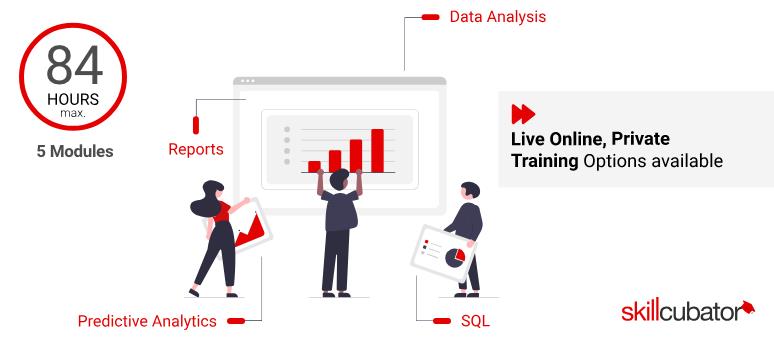
The exponential growth in data has transformed all verticals such as finance, healthcare, manufacturing, retail, telecom, energy, etc. With the advent of huge sets of data created every second, organizations find it difficult to translate this huge amount of raw data into actionable insights.
This has eventually created a huge demand for professionals who can turn this raw data into meaningful information. In Skillcubator’s Data Analysis & Analytics training program, you can complete the course with an impressive professional portfolio and technical skills needed to solve real-world data problems.
Are you a creative, curious, and ambitious professional looking to join the data revolution? Or if any of the following describes your situation, then enrolling in our Data Analytics training and placement program could be a smart career move.
- You want to switch to the IT field and start your career in data analysis, data analytics or business intelligence areas
- You are currently a professional working with data but are looking to advance your career by building technical skills
- You are a manager or professional in a business where data can be used to boost your company’s bottom line
- You have interests in visualizing data to gain better insights, determine trends or any hidden patterns or correlation across huge data sets
Anyone aspiring to become a data analyst. NO PRIOR IT EXPERIENCE IS REQUIRED.
INTRODUCTION TO DATA ANALYSIS/DATA ANALYTICS
- Introduction To Data Analytics.
- Data Analytics Concepts Overview.
- Understanding Descriptive Analytics, Diagnostic Analytics, Predictive Analytics And Prescriptive Analytics.
- What Is A Data?
- Understanding Different Types of Data, And Data Structures.
- Data Visualization for Decision-making.
- Difference Between Data Analytics And Business Intelligence.
- Creating Data Flow Diagram (DFD).
- Application Of Data Analytics In Different Business Domains.
- Data Analytics Framework and Latest Trends.
DATA ANALYTICS WITH MICROSOFT EXCEL
- Microsoft Excel 101 (Basics of formula creation, Arithmetic functions, Statistical functions, Advanced functions (Index-Match), Conditional Formatting, VLOOKUP, HLOOKUP, XLOOKUP, Duplicate removal, Filtering and Sorting etc.).
- Advanced Functionalities in Microsoft Excel such as Pivot Tables, and Pivot Charts .
- How to Create and Manage An Interactive Dashboard Using Slicers?
- Exporting Dashboard And Sharing It With Key Stakeholders.
- Power Pivot, Power Query In Excel For Data Transformations And Automated Refreshing.
- Creating Different Types Of Charts. (Pie, Bar, Column, Histogram, Line, Area, Scatter, etc.).
- Learn How To Perform Key Statistical Functions Like (a) Regression Analysis (b) Correlation Analysis Using Microsoft Excel.
STRUCTURED QUERY LANGUAGE (SQL)
DATABASE FUNDAMENTALS
- Introduction To Databases.
- What Is DBMS And RDBMS?
- Understanding Database Schema?
- Creating Entity Relationship Diagram (ERD).
- Different Types Of Databases?
- Normalization & Denormalization
- Relational Database Concepts (Tables, Rows, Columns).
- Installing SQL Software (My SQL).
INTRODUCTION TO SQL
- What is SQL?
- Types Of SQL Commands (DDL, DML, DQL, DCL, TCL).
DATA TYPES
- Integer, Float, Double, char(25), Varchar (256), Datetime, Timestamp.
DDL COMMANDS
- Create, Alter, Drop, Truncate.
DML COMMANDS
- Insert, Update, Delete.
BASIC QUERING (DQL)
- Select Queries (Select *, Limity, Distinct, Order By, Where Clause, Logical Operators, Between, In/Not In, And/Or/Not Operators, Like and Wildcards.
DQL COMMANDS, CASE STATEMENTS, AND HANDLING NULL VALUES
- Mathematical Operators (Min, Max, Count, Distinct Count, Average, Sum).
- Aggregation Specific Operators (Group By And Having).
- Date & Time Functions.
- Handling Null Values (IFNULL, COALESCE).
SQL STRING FUNCTIONS
- CONCAT, SUBSTRING, LENGTH, TRIM, UPPER/LOWER.
SQL MATHEMATICAL FUNCTIONS
- ROUND, CEILING, FLOOR.
SQL DATE AND TIME FUNCTIONS
- NOW(), DATE(), YEAR(), MONTH(), DATEDIFF().
AGGREGATION AND GROUPING
- COUNT, SUM, AVG, MIN, MAX, GROUP BY, HAVING.
JOINS
- Inner Join, Left Join, Right Join, Full Outer Join.
SPEFICAL FUNCTIONS, SUB-QUERIES AND CTES AND VIEWS, ORDER OF EXECUTION
- Windows Function-Rank, Dense Rank, Lead, Lag, Row Number, Union, Union All, Sub-Queries, Common Table Expressions, Views, Order Of SQL Query Execution.
VIEWS AND INDEXES
- Creating Views, Updating Views, Index Basics.
TRANSACTIONS
- Commit and Rollback.
USER ACCESS CONTROL
- Grant, Revoke.
MICROSOFT POWER BI
- What Is Data Visualization?
- Introduction To Microsoft Power BI.
- Microsoft Power BI Installation.
- Difference Between Microsoft Power BI Desktop & Microsoft Power BI Report Server.
- Understanding Microsoft Power BI User Interface.
- Understanding Type Of Visualization Techniques.
- Loading Data Into Microsoft Power BI From Multiple Sources.
- Creating A Data Model Between Different Tables.
- Creating Microsoft Power BI Dashboards.
- Understanding Different Graphs, Parameters, Slicers.
- Microsoft Power BI AI Visuals And Power Query (AI visuals in Power BI (Key Influencers, Smart Narratives, Decomposition Tree, Anomaly Detection, Q&A), Transformations using Power Query editor).
- The world of DAX: A Detailed View Into The World Of DAX Queries.
- Learning Advanced Concepts (Understanding Tooltips, Drill Down Options, Visual Interaction, Buttons, Bookmarks, Navigation, Join and Merge Queries).
PYTHON FOR DATA ANALYTICS
- Fundamentals Of Programming.
- Anaconda Installation, Introduction to Python, Data Types, Operators, Slicing The Data, Inbuilt Functions In Python.
- Advanced Python Functions (Sets, Conditional Statements & Loops, Functions & Error Handling).
- Understand Pandas And Numpy For Data Analysis.
- Exploring Data (Head, Info, Describe), Cleaning Data: Missing Values, Duplicates, Type Conversion And Transformations: Sorting, Filtering, New Columns, Aggregations, Merging.
- Data Visualization With Matplotlib & Seaborn.
- Training program as per latest industry demands
- IIBA Endorsed Education Provider
- Access to Learning Management System (LMS)
- Free PSM-1 and PSPO-1 training
- 35 PDUs/CDUs
- IIBA certified instructors with 20+ years of experience
- Plenty of case studies, in-class exercises, quizzes, and take-home assignments
- 10+ industry-standard tools
- Personalized resume, LinkedIn Profile makeover, and cover letter
- Course aligned to IIBA’s BABOK 3.0 and PMI’s body of knowledge
- Comprehensive Capstone project
- Experiential learning through case studies
- Microsoft Office (Word, Excel, PowerPoint)
- Microsoft Visio, Gliffy, Lucidchart
- MySQL
- Jira
- Confluence
- Microsoft Power BI
- Jupyter

Yes. Data Analysis/Analytics is all about extracting raw data and using the tools and techniques, converting that raw data into meaningful information for organizations to make important decisions. Whereas, Business Analysis is geared toward bringing change within an organization through strategic and operation solutions. Oftentimes, Business Analysis entails building Information Technology solutions.
Not really. You don’t need to learn a programming language for a Data Analyst/Data Analytics role. The most common set of tools and techniques are Microsoft Excel, SQL and Data Visualization tools like Microsoft Power BI or similar tools.
We have added basics of Python in our Data Analytics program since few Data Analytics role demand Python programming. Python is easy to learn even if you don’t have any technical background and have never done programming.
While the main goal of our training is to train a candidate for a Data Analyst / Data Analytics professional role and also help a candidate to clear the Data Analyst certification, offered by IIBA. Please read more on that by clicking on https://www.iiba.org/business-analysis-certifications/business-data-analytics-certification/
Absolutely yes. We can help you transition into a Data Analyst/Data Analytics role irrespective of your past experience, knowledge or skills. As long as you have (a) decent communication skills (b) Reasonable logical reasoning skills and (c) basic understanding of computers, we guarantee that you will be transformed into a Data Analyst/Data Analytics role, equipped with all the required knowledge, skills, and expertise.
Truly speaking there are absolutely no prerequisites to become a successful Data Analyst/Data Analytics professional. But it would be nice to have the following, prior to the training
- Familiar with Microsoft Excel basic features
- Decent communication skills (verbal and writing in English)
- Comfortable playing around with data
Total cost of the training program is 1500 USD + 5.3% Sales Tax, which includes study material, training tools, access to the Learning Management System (LMS), three certifications, resume preparation, cover letter, LinkedIn profile, mock interview preparation, placement, and post-placement support.
You will receive the following
- Certificate of Completion issued by Skillcubator Training Institute with IIBA endorsement
- Professional Scrum Master (PSM) Level-1 from Scrum.org (Optional)
- Professional Scrum Product Owner (PSPO) Level-1 from Scrum.org (Optional)
[Please Note: Trainees must pay the exam fees directly to Scrum.org for PSM-1 and PSPO-1 exams. Training for both these exams is included in our ‘Data Analysis/Data Analytics’ training and placement Program and we guarantee 95% or more grades in both these exams in the very first attempt. Otherwise Skillcubator will reimburse your exam fees, which you paid to Scrum.org]
Yes. You will be required to use industry-standard tools, which are usually used by Data Analyst/Data Analytics professionals around the world. However, there is no additional cost for using these tools. There are approximately 10 different industry-standard tools that we use during the course of training.
[Please Note: Instructor reserves the right to make changes to the suite of tools depending on the current industry demand]
- What are the different tools I will learn during the course of the training?
For business analysis training, we use more than 12 industry-standard tools. Please see the following
- Microsoft Office (World, Excel, and PowerPoint): For general purposes like creating requirements documents, presentations, in-class exercises, and data analysis
- Microsoft Visio, Draw.io, Gliffy, Lucidchart: For creating various types of models and diagrams
- Balsamiq and Mockflow: For wireframes and mockups
- Jira: Project tracking purposes
- Confluence: Content repository
- Tableau and Power BI: Data visualization, creating dashboards, reports, etc.
- Tortoise SVN: Configuration and change management
- Oracle: Structured Query Language (SQL)
[Please Note: Instructor reserves the right to make changes to the above-mentioned suite of tools depending on the current industry demand]
Yes. Our course is aligned with IIBA’sⓇ BABOKⓇ version 3.0 and PMIⓇ PBAⓇ body of knowledge.
Yes. Our ‘Data Analysis/Data Analytics’ training is recognized by IIBA and you can also claim 35 PDUs/CDUs.
IIBAⓇ(International Institute of Business Analysis) is a not-for-profit organization geared towards the advancement of the business analysis discipline. You can find more on IIBA by clicking the following URL https://www.iiba.org/about-iiba/
BABOKⓇ (Business Analysis Body of Knowledge) is a guide about business analysis issued by the International Institute of Business Analysis (IIBA), attempting to reflect current best practices and to provide a framework that describes the areas of knowledge with associated activities, tasks, and techniques required.
PMIⓇ(Project Management Institute) is a not-for-profit organization that aims to promote and standardize the project management discipline.
The concepts, principles, tools, and techniques taught are domain agnostic. Means, it can be applied irrespective of any domain. But if you have any specific domain in mind, please let us know. We will work with you to give you additional training in that particular domain.
Yes. We provide training in the following business domains
- Electronic Payment Processing
- Healthcare
- Insurance
- Investment Banking
- Primary Mortgage
- Secondary Mortgage
- Retain Banking
Please click on the following link to view the detailed course outline

“PMI®“, “PMBOK®“, “PMP®“, “PMI-RMP®“, “CAPM®” and “PMI-ACP®” are registered marks of the Project Management Institute, Inc.
IIBA®, the IIBA® logo, BABOK® and Business Analysis Body of Knowledge® are registered trademarks owned by International Institute of Business Analysis.CBAP® is a registered certification mark owned by International Institute of Business Analysis. Certified Business Analysis Professionalisa trademark owned by International Institute of Business Analysis.


COURSE DELIVERY OPTION
- Live 'Instructor-Led' Online.
- Private Team Training.

PREREQUISITES
Even though there are no prerequisites to take our Data Analysis & Analytics training program, it would be nice to have basic computing skills, decent communication skills (verbal and writing in English) and feel comfortable playing around with data.