





 Leave a Comment on How to Build Niche Expertise in Business Analysis
How to Build Niche Expertise in Business Analysis
You completed your Business Analysis training. You earned the certification. You updated your resume with the right keywords. And yet, you keep hitting the same wall: shortlists that go nowhere, roles filled by someone with more “relevant” experience and hiring managers who seem to want something you can’t quite put your finger on. Here’s what they’re looking for: depth over breadth. A niche.
The Business Analysis job market is not short of generalists. What it is short of and what commands real career longevity and competitive salaries is Business Analysts who combine core BA skills with deep platform or domain expertise. This blog breaks down why niche matters, which specializations carry the most weight right now, and how mid-career professionals can build that expertise intentionally.
TL; DR — What This Blog Covers
- Why generic BA skills are no longer enough to stand out
- The most in-demand niche domains for Business Analysts in 2026
- How domain expertise changes the way you’re evaluated by hiring managers
- A practical path to building niche BA expertise from where you are now
- How Skillcubator’s training is designed around placement in specialized roles
The Problem with Being a “Generalist BA”
Business Analysis as a discipline is well-understood. Requirements gathering, stakeholder management, process documentation, user stories, these are skills most trained BAs share. That’s precisely the problem.
When every candidate brings the same foundational toolkit, hiring managers are forced to differentiate on something else. And that something else is almost always domain knowledge, platform familiarity, or industry context.
A niche specialized BA understands Salesforce objects, flows, approval processes, and how to translate a business requirement into a declarative configuration decision. Those two profiles are not competing for the same jobs. And they’re not being paid the same salary.
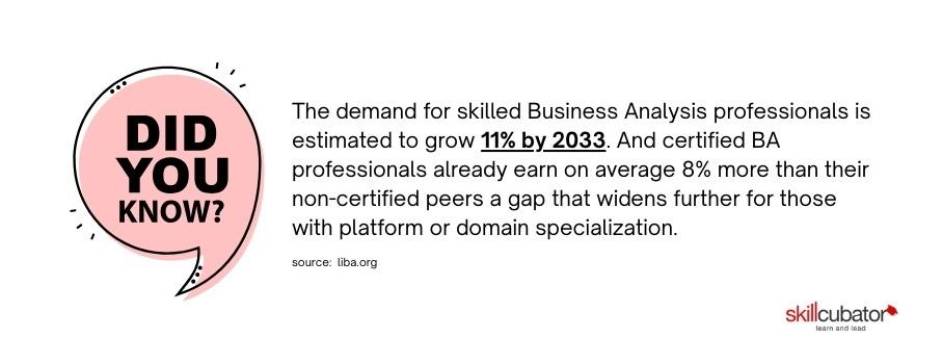
What Niche Expertise Actually Means for a BA
Niche expertise in Business Analysis is not just about knowing a tool. It sits at the intersection of three things:
- Platform or domain technical literacy understanding how the system or industry actually works
- BA practice applied in that context writing requirements, user stories, and process flows that reflect real platform constraints
- Industry or regulatory fluency understanding the business pressures, compliance requirements, and stakeholder dynamics specific to that domain
When you combine all three, you stop being a BA who happens to have worked on a Salesforce project. You become a Salesforce BA for someone who is actively sought out, rather than one thirty applicants being screened.
The Most In-Demand Niche Domains for Business Analysts
Not all niches are created equally. Some carry more demand, better salary premiums, and more structured career pathways than others. Here are the specializations worth knowing and building.
1. Salesforce BA
Salesforce remains one of the most widely implemented CRM and business platform ecosystems globally. Organizations implementing or optimizing Salesforce need BAs who understand the product deeply not just from a requirements perspective, but from a configuration and data model standpoint. Salesforce BAs are in demand at SIs (System Integrators), enterprise clients, and Salesforce consulting partners.
2. ServiceNow BA
As enterprises accelerate digital workflows and IT service management, ServiceNow has become a dominant platform across ITSM, HRSD, CSM, and GRC. ServiceNow BAs bridge the gap between business process owners and technical implementation teams, translating workflow requirements into module-specific configurations. Demand is especially strong in managed service providers and large enterprises undergoing IT modernization.
3. Guidewire BA
Guidewire is the leading insurance platform for property and casualty (P&C) carriers worldwide. It’s a smaller niche but an extremely well-compensated one. BAs with Guidewire experience in policy, billing, and claims are actively recruited by insurers and consulting firms that implement Guidewire, and the supply of qualified candidates is consistently lower than demand.
Also Read
4. Fintech / BFSI BA
The financial services sector for banking, insurance, and capital markets has some of the highest demand for specialized BAs. What makes this niche distinct is the compliance and regulatory layer: understanding payment flows, AML/KYC requirements, core banking systems, or lending operations turns a general BA into a highly credible finance-domain specialist. Fintechs, NBFCs, and traditional banks actively seek this profile.
5. Cloud BA (AWS / Azure)
As organizations move workloads and business processes to the cloud, they need BAs who can think in cloud-native terms. A Cloud BA understands how to write requirements for cloud migration projects, cost optimization exercises, and infrastructure governance decisions, working alongside solution architects and technical teams rather than just being a conduit to them.
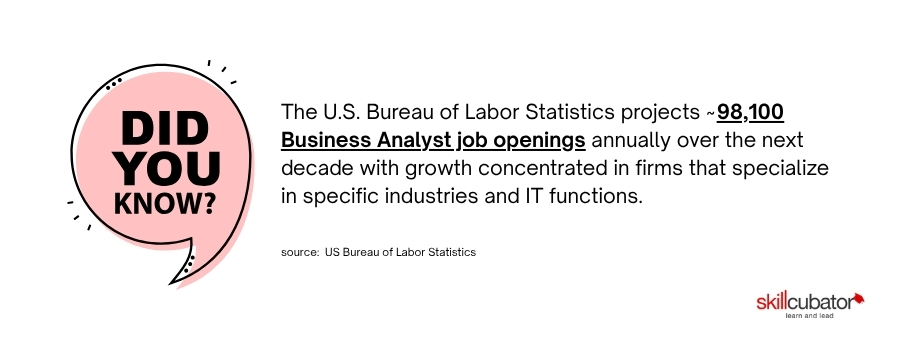
Generalist vs Niche BA: What Hiring Managers Actually See
The table below illustrates how the same role looks very different depending on whether the candidate brings niche depth or stays broad.
| Salesforce | Knows CRM concepts broadly | Understands Salesforce objects, flows, and declarative config | Targeted by SIs and enterprise teams |
|---|---|---|---|
| ServiceNow | Familiar with ITSM theory | Translates business needs into ServiceNow modules and workflows | High demand in managed service firms |
| Guidewire | Generic insurance BA knowledge | Domain expertise in P&C, policy, billing, claims modules | Niche but very well-paid |
| Fintech / BFSI | General requirements writing | Understands regulatory constraints, payment flows, compliance BA | Sought by banks, fintechs, NBFCs |
| Cloud (AWS/Azure) | Aware of cloud concepts | Writes cloud migration requirements, cost-benefit analysis, governance docs | Valued by IT transformation teams |
Also Read
How to Build Niche Expertise Without Starting from Scratch
The most common mistake mid-career professionals make is assuming niche expertise requires years of direct employment in that domain. It doesn’t, but it does require intentional, structured learning.
Here’s a practical path:
- Choose a niche that maps to your background. If you come from banking, BFSI BA is a natural fit. If you have IT service experience, ServiceNow is a credible first move. The learning curve is shorter when the domain isn’t entirely foreign.
- Go beyond theory into platform literacy. Read platform documentation. Complete vendor learning paths (Salesforce Trailhead, ServiceNow’s Now Learning). Understand the data model, key modules, and common implementation patterns.
- Practice applying BA skills inside the niche. Write a requirements document for a Guidewire claims module. Map out a Salesforce Lead-to-Opportunity process. Build a user story set for cloud migration. These artefacts become your portfolio.
- Build your vocabulary. Each domain has a language. Learning to speak it fluently with the right terminology in the right context signals insider knowledge to hiring managers within the first five minutes of an interview.
- Seek training that integrates domain context. Generic BA courses teach the method. Placement-aligned programs that embed platform or domain context into live exercises produce professionals who can credibly discuss niche roles from day one.
How Skillcubator Builds Niche-Ready Business Analysts
Skillcubator’s Business Analysis programs are designed for exactly this challenge. Rather than delivering generic BA theory, every program is built around the hiring outcome which means embedding real domain context, tool exposure, and industry-relevant scenarios directly into the curriculum.
Instructors bring active platforms and domain experience. Learners practice writing requirements and process artefacts in context, not in the abstract. Interview preparation is integrated throughout, not bolted on at the end.
The result is a BA profile that does not just list certifications; it demonstrates readiness for a specific kind of role. That difference is what moves a resume from the maybe pile to the interview shortlist.
Final Thoughts
The market is not short of Business Analysts. It is short of Business Analysts who know something deeply, who speak the language of a platform or industry, and who can demonstrate applied capability, not just certification.
Building a niche is not a shortcut. It takes deliberate effort, structured practice, and training that is built with placement in mind. But once you have it, the career dynamics shift. You stop competing on volume and start standing out on value.
If you’re a mid-career professional ready to make that shift, the path starts with choosing your niche and committing to it with the right program behind you.
Skillcubator’s BA programs are built around the niche expertise hiring managers actually look for. Whether you’re transitioning into Business Analysis or ready to level up your current profile, our courses give you the domain depth, tool fluency, and interview confidence to compete differently. Reach out to the Skillcubator team to find the right path for your background and goals.
You cannot copy content of this page