




 Leave a Comment on How to Choose the Right IT Course Based on Your Career Goal and Not Trends
How to Choose the Right IT Course Based on Your Career Goal and Not Trends
The IT industry is moving fast. Every few months, there’s a new “must-learn” skill dominating LinkedIn feeds, cloud, AI, cybersecurity, and data engineering.
But if you’re a working professional planning your next move, trends shouldn’t drive your decision. Career alignment should.
Choosing the right IT certification courses isn’t about what’s popular this year. It’s about what positions you for the role you want and the credibility you need, especially in competitive markets like the US.
This guide will help you evaluate the right professional IT courses based on your background, target role, and long-term outcomes, not buzzwords.
TL; DR – What This Blog Covers
- Why trend-based decisions fail
- How to align IT certification courses with career outcomes
- How to evaluate experience before selecting professional IT courses
- When to choose Business Analysis vs Cloud vs Data vs Project Management
- Why instructor-led IT training works better for serious professionals
- How to approach a structured career transition to IT
The Cost of Choosing Courses Based on Trends
There’s nothing wrong with cloud computing. Or data analytics. Or cybersecurity. The mistake happens when professionals choose a course because “everyone is doing it.” Trends don’t guarantee fit.
For example:
- A finance professional may jump into cloud architecture without enjoying infrastructure work.
- An operations manager might enroll in data science without truly liking analytics.
- A senior IT engineer might pursue random certifications without aligning them to a leadership path.
Six months later, they have a certificate, but no strategic direction. Your goal shouldn’t be to collect certifications. It should be to strengthen your career narrative.
Start With the Role You Want to Build Toward
Before evaluating Business Analysis certification courses or professional IT courses in cloud or cybersecurity, ask a more important question:
Where do I want my career to move in the next two to three years?
Do you see yourself working closely with business stakeholders and translating requirements into solutions? Do you prefer designing scalable systems and infrastructure? Are you more energized by coordinating teams and managing delivery timelines? Or do you enjoy working with data, insights, and decision-making models?
Your answers matter more than market noise.
Once you define the role, certifications become strategic tools. Without that clarity, even the most reputable IT certification courses can feel directionless.
Aligning Your Background with the Right Track
One of the biggest misconceptions about a career transition to IT is that you must start over. In reality, most successful transitions are extensions, not reinventions.
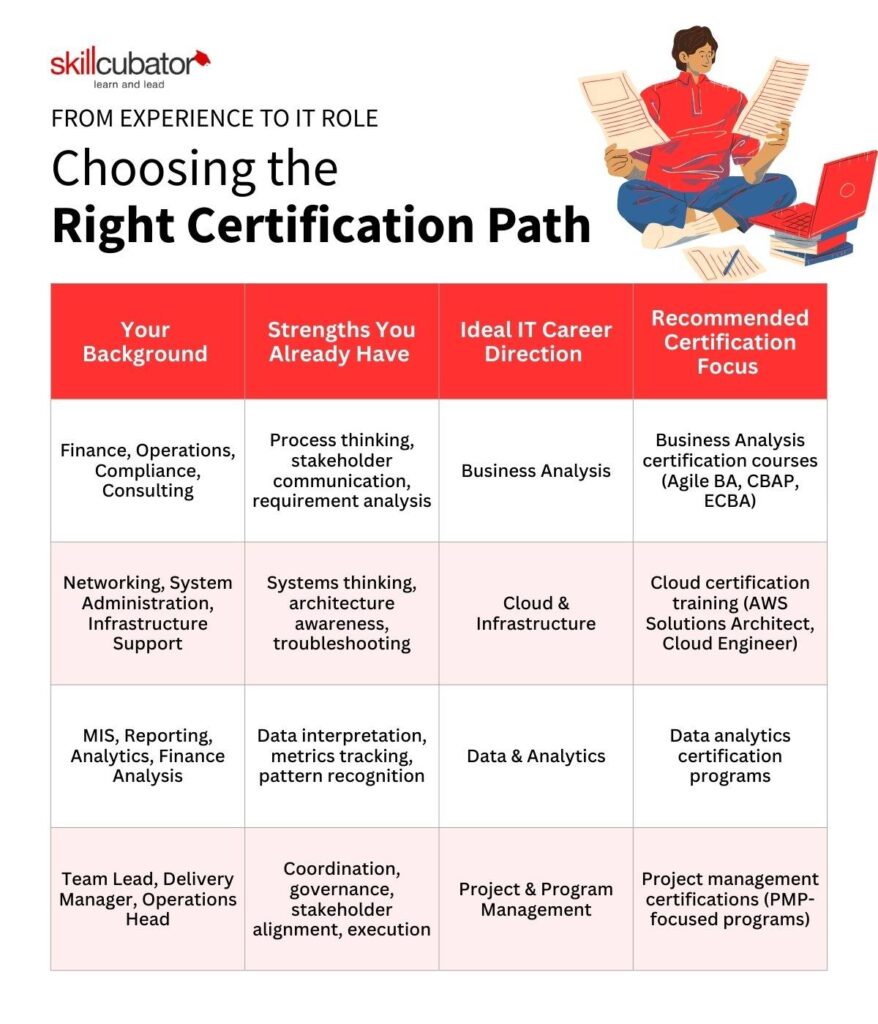
Professionals from finance, operations, or consulting often underestimate how relevant their experience is. Business Analysis certification courses, for example, build on structured thinking, stakeholder communication, and process mapping skills that are already part of many non-technical roles. According to the U.S. Bureau of Labor Statistics, demand for business and financial operations roles remains steady alongside tech growth, making hybrid skill sets increasingly valuable.
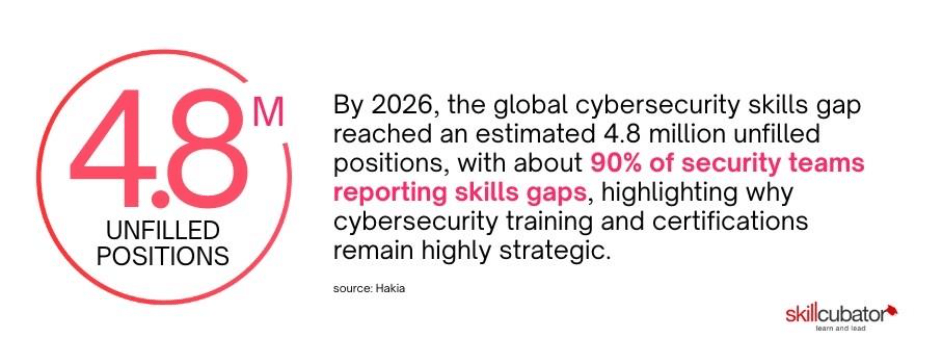
For technical professionals in networking or systems administration, cloud certification training, such as AWS Solutions Architect, typically strengthens existing infrastructure knowledge rather than replacing it. Cloud roles continue to expand as enterprise cloud adoption surpasses 90% globally.
Similarly, professionals comfortable with reporting and metrics may find data analytics certification paths more aligned than purely engineering-focused roles. And those experienced in coordination and governance often benefit more from project management certifications than deep technical specializations.
The pattern is simple: your next training/certification should compound your strengths and not contradict them. Ultimately, technical skills can be learned, but business context is earned. This is why your professional background isn’t a hurdle; it’s your greatest competitive advantage in the IT landscape.
From Experience to IT Role: Choosing the Right Certification Path
Why Instructor-Led IT Training Matters at This Stage
For early exploration, self-paced platforms can be useful. But for serious career acceleration, structure becomes essential.
Working professionals balancing full-time roles cannot afford trial and error. Instructor-led IT training provides something that self-paced programs often lack: guided clarity. Real-time explanations, structured pathways, accountability, and mentorship significantly reduce confusion.
When you are investing time and money into professional IT courses, completion is not enough. Confidence and practical understanding matter more.
Guided learning creates discipline. Discipline creates credibility. And credibility drives career mobility.
Also Read
Certifications as Career Positioning Tools
Especially in the US job market, certifications often serve as screening mechanisms. Recruiters use them as filters. Hiring managers view them as structured validation of capability.
However, not all certifications carry equal strategic value. Randomly stacking credentials does not strengthen your profile.
Strategically selected IT certification courses aligned with your desired role to create narrative consistency. They signal intentional development. They reinforce your career’s direction.
When certifications align with role clarity and instructor-led training, they become credibility multipliers.
A Practical Way to Think Before You Enroll
Before committing to any course, pause and think sequentially. First, define the role you want to move toward. Second, identify the skills that the role demands. Third, choose trainings/certifications that validate those skills in recognized markets. Finally, select instructor-led IT training that ensures you actually master and apply the knowledge. This sequence protects you from trend-driven decisions. It ensures your effort to compound instead of scattering.
Final Thoughts
The right IT course is rarely the loudest one online. It is the one that strengthens your professional direction, builds your existing strengths, and enhances your credibility in the market you’re targeting.
Career growth, especially at a mature stage, is not about chasing what’s trending. It’s about positioning yourself intelligently.
If you’re ready to plan your IT transition with clarity and expert guidance, get in touch with the Skillcubator team to discuss the right learning path for you.
You cannot copy content of this page