




 Leave a Comment on A Realistic Career Transition Plan into IT for Mid-Career Professionals
A Realistic Career Transition Plan into IT for Mid-Career Professionals
Thinking about a career change to IT at 30, 35, or even 40 often comes with a quiet panic that most people don’t say out loud. You might already be doing well in your current role, but something feels off, limited growth, skills that no longer feel future-proof, or a growing sense that technology is where long-term opportunities live.
At the same time, the internet doesn’t make things easier. One side says, “anyone can switch to tech”, while the other warns that it’s too late unless you started coding at 21. The truth sits somewhere in between.
This blog is written for:
- Mid-career professionals aged 30–45 in the USA and Canada who are considering a career change to IT, particularly those from non-technical backgrounds such as banking, finance, insurance, logistics, retail, operations, sales, healthcare, or administration.
- It speaks to professionals who already have work experience, transferable skills, and career maturity, and are looking for a realistic, low-risk, structured path into IT through upskilling, reskilling, and recognized IT certifications, without starting from scratch or taking a salary hit.
TL; DR: What This Blog Covers
If you’re short on time, here’s the gist.
- Whether it’s too late to switch to IT at 30, 35, or 40
- Realistic IT career paths for non-tech professionals
- Entry-level IT roles that don’t mean starting over
- Transferable skills you already have and how to use them
- Certifications that actually help career switchers in the US & Canada
- Why instructor-led training works better for mid-career professionals
Is It Too Late to Start a Career in IT at 40?
One of the most common questions people search for is simple: “Is it too late to start a career in IT?”
The concern isn’t really about age; it’s about risk.
Mid-career professionals don’t have the luxury of trial and error. You’ve built experience, income stability, and professional credibility, and the idea of starting over can feel unrealistic. The good news is that modern IT careers don’t reward age as much as they reward role readiness.
Technology teams today need professionals who can communicate, plan, analyze, and execute, not just write code. That’s why roles like business analysis, data analytics, project management, cloud computing, and cybersecurity actively benefit from career maturity. When approached strategically a career change to IT, even at 30 or beyond, isn’t too late; it’s often better aligned than starting fresh with no context.
Did You Know?
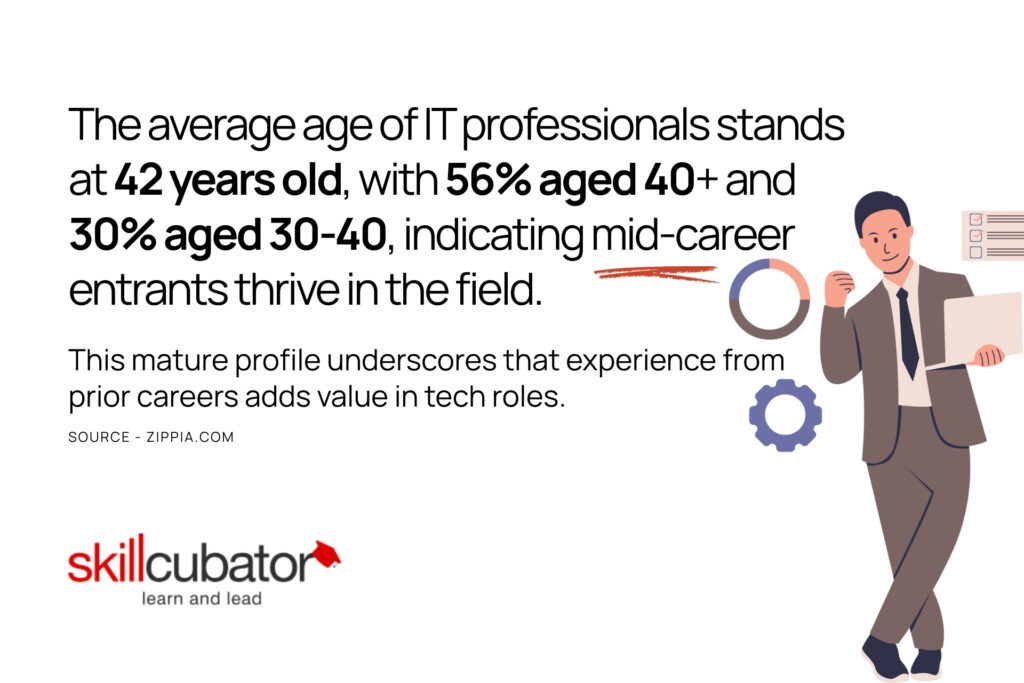
78% of career changers fall in the 25-44 age range, aligning with mid-career pros; 23% of 30-34-year-olds and 17% of 35-39-year-olds actively seek switches
Switching Careers from Non-Tech Background to Tech: What People Get Wrong
Many professionals switching careers to tech start with self-paced learning. Online courses, YouTube tutorials, or weekend certifications feel like a safe first step. While these resources build awareness, they often fail to create confidence. The issue isn’t motivation, it’s structure.
Non-tech professionals don’t struggle because they can’t learn technical concepts. They struggle because they don’t know how those concepts translate into real jobs. This is where unguided, self-based learning tends to break down. You finish a course but still feel unsure whether you’re ready or what to do next.
Successful transitions rely on intentional upskilling and reskilling, supported by professional development that mirrors real-world expectations. Instructor-led programs consistently perform better for mid-career professionals because they provide clarity, feedback, and accountability things that matter far more once you’re past the beginner stage.
Do You Really Need to Start from Scratch?
Not at all. Mid-career professionals don’t need to reset their careers to move into IT. The smarter approach is to choose a role that builds existing experience while offering enough technical exposure to grow confidence gradually. This reduces unnecessary pressure and allows you to transition into IT without discarding the skills and credibility you’ve already earned.
Many of the highest-paying IT jobs without a computer science degree exist precisely because they value transferable skills.
In the US and Canada, hiring managers often prioritize candidates who understand processes, stakeholders, and real-world constraints. When certifications are paired with experience, entry-level roles become stepping stones, not setbacks. This is often the shortest path to a tech career that still respects the work you’ve already done.
Take the Skillcubator Self-Assessment Tool (SAT) to determine the learning approach that fits you best.
The Transferable Skills You’re Probably Undervaluing
One of the biggest mental blocks in career transitions is underestimating what you already bring to the table. Professionals from banking, sales, healthcare, or operations often assume their skills won’t matter in IT. In reality, many IT roles depend on them.
Project planning, business process management, stakeholder management, communication, risk management, and analytical thinking are foundational in technology environments. When combined with growing technical literacy, hands-on labs, and portfolio building, these skills become a strong differentiator.
Networking, especially on LinkedIn, also plays a major role here. Mid-career professionals who frame their experience correctly and show a clear transition narrative often gain traction faster than those who simply list courses they’ve completed.
A Practical IT Career Path for Mid-Career Professionals
A successful IT career path for mid-career professionals starts with restraint, not urgency. The biggest mistake people make is learning tools before deciding on roles.
A more realistic approach begins with identifying roles that align with your background, then choosing certifications and skills that reinforce that direction. This reduces risk and helps you transition to IT without losing salary.
Structured learning, guided certification paths, and applied practice matter here. Certifications still carry weight, especially in the North American market,s but only when they’re backed by real understanding and contextual application. This is where hands-on labs and instructor feedback become crucial.
Instead of chasing everything, a focused path allows you to build momentum without burning out or second-guessing every decision.
Also Read
The Most Practical IT Certifications for Career Switchers in 2026
Not all certifications are equally valuable for career changers. For mid-career professionals, the most effective certifications are those that complement existing experience rather than replace it.
Project Management certifications, such as PMP or Agile frameworks are particularly effective for professionals from finance, operations, or consulting backgrounds. They align naturally with IT delivery roles and are widely recognized across industries.
Business Analysis certifications work well for those who understand business processes and want to bridge the gap between technical teams and stakeholders. These roles value clarity, documentation, and decision-making as much as technical awareness.
Cloud and DevOps certifications remain in demand, but they require structure. When approached through instructor-led programs with guided labs, they offer one of the strongest long-term returns for professionals moving into IT infrastructure and operations.
If Business Analysis feels like a natural next step, you may find it useful to explore Skillcubator’s Business Analysis training programs, which are built around practical, role-aligned learning.
Why Instructor-Led Training Works Better for Mid-Career Transitions
For experienced professionals, learning is less about speed and more about confidence. Instructor-led training provides context, feedback, and reassurance that self-paced courses often lack.
It also removes guesswork. Instead of asking “Am I doing this right?” you gain clarity through mentorship and real-time guidance. This is especially valuable for professionals who have already attempted self-learning and felt stuck despite putting in the effort.
Upskilling and reskilling are far more effective when they’re structured around outcomes, not content volume.
Making the Transition Without Guesswork
Switching careers to tech doesn’t have to be dramatic or risky. When planned well, it’s a progression, not a reset.
If you’re considering a career change to IT at 30, 35, or 40, the key is to treat it like any serious professional decision: assess your strengths, choose a realistic path, and invest in guidance that reduces uncertainty.
With the right certifications, instructor-led support, and a clear role of focus, transitioning into IT becomes less about starting over and more about moving forward with intent.
If you’re ready to plan your IT transition with clarity and expert guidance, get in touch with the Skillcubator team to discuss the right learning path for you.
You cannot copy content of this page