




 Leave a Comment on Top Skills to Build In 2026 for an IT Career Transition
Top Skills to Build In 2026 for an IT Career Transition
The idea of transitioning into IT has changed significantly over the last few years. In 2026, it’s no longer about “learning to code” or starting from scratch. Instead, the most successful career transitions into IT are happening when professionals build on what they already know about domain expertise, decision-making, problem-solving, and combine it with the right technical, digital, and people skills.
This is especially true in the USA and Canada, where employers place strong value on structured learning, recognized certifications, and role readiness. Whether you’re already working in IT, managing projects, or coming from a non-technical background like banking or finance, the opportunity isn’t about chasing trends. It’s about choosing the right direction.
This blog looks at the top tech skills to learn in 2026, grouped into clear career tracks, so you can plan your IT career transition with intent, not guesswork.
TL; DR: What This Blog Covers
If you’re short on time, here’s the gist.
- This blog explains why career-track-based learning works better than random upskilling, highlighting the most practical IT roles to transition into in 2026.
- And breaks down how certifications and structured learning can accelerate career growth, especially for professionals moving from non-IT tech to IT.
What Is the Fastest Way to Transition into IT in 2026?
The fastest way to transition into IT in 2026 is not by collecting as many skills as possible. It’s by choosing a career track that aligns with your existing experience and the current hiring landscape.
For example, a banking professional doesn’t need to become a full-stack developer to enter tech. They are far better positioned moving into business analysis, product management, data analytics, cybersecurity, and project management roles where their domain knowledge adds immediate value. Similarly, project coordinators and operations managers often transition more smoothly into managerial tracks like IT Project Manager, Scrum Master, than purely technical ones.
This is why career-track-based learning has become central to IT career transitions. Instead of asking, “What skill should I learn?”, the better question in 2026 is, “Which IT role am I positioning myself for?”
Find Your Bridge to IT in 2026
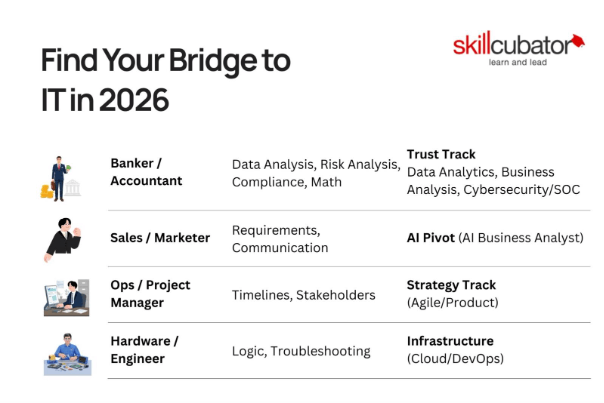
The AI Pivot Track: Is Business Analysis a Good Career in 2026?
AI continues to dominate conversations around technology, but not every role in AI requires deep programming expertise. One of the most practical and fastest-growing entry points into AI-led IT roles is AI Business Analysis.
Did You Know?
Job postings requiring AI skills nearly doubled, rising from about 5% in 2024 to over 9% in 2025 per Indeed’s analysis. AI tops growth lists for IT skills in 2026 postings
In 2026, organizations are actively looking for professionals who can identify where AI adds business value, translate requirements into AI-driven workflows, and work alongside technical teams. This makes AI Business Analysis especially attractive for professionals transitioning from finance, operations, consulting, or even traditional IT roles.
Prompt engineering has also emerged as a complementary skill within this track. While it may sound technical, its real-world application is largely strategic, understanding how to interact with AI systems to produce reliable business outcomes. For many professionals, this represents a rare opportunity to move into AI-focused roles without needing to become developers.
For those planning an IT career transition in 2026, this track offers strong demand, relevance across industries, and long-term growth potential, particularly in North American markets.
If Business Analysis feels like a natural next step, you may find it useful to explore Skillcubator’s Business Analysis training programs, which are built around practical, role-aligned learning.
The Trust Track: Are Cybersecurity and Data Privacy Still in Demand in 2026?
If there is one area of IT where demand has only intensified, it’s cybersecurity. As organizations in the USA and Canada deal with stricter regulations, rising cyber threats, and increased digital dependency, trust-focused roles have become mission-critical.
SOC Analysts and data privacy professionals sit at the center of this shift. These roles are well-suited for professionals from banking, compliance, risk management, or audit backgrounds who already understand governance and accountability. Transitioning from non-tech to IT becomes far more achievable when your existing experience directly supports the role.
What makes cybersecurity particularly appealing in 2026 is that employers value certification-backed competence. Structured training and instructor-led programs often carry more weight than self-paced learning alone, especially in roles that involve real-world risk.
For beginners entering IT, cybersecurity remains one of the highest-paying and most stable career paths, provided the transition is done strategically.
Also Read
The Strategy Track: Can Agile and Product Roles Help You Transition into IT?
Not every IT role is hands-on technical, and that’s where the Strategy Track comes in. Agile Scrum Masters and Product Managers play a critical role in ensuring technology delivers real business value. In 2026, these roles continue to grow as organizations scale digital transformation initiatives.
This track is particularly effective for professionals who already manage teams, timelines, or stakeholders. Project managers, business leads, and even senior individual contributors often find that Agile and Product roles allow them to transition into IT without discarding years of experience.
In North American job markets, certifications like PMP, Agile, and Scrum remain strong signals of credibility. More importantly, they demonstrate structured thinking, delivery capability, and leadership qualities employers actively seek when hiring for tech-driven roles.
For professionals aiming to move into IT while maintaining a leadership or strategic focus, this track offers clarity and stability.
Take the Skillcubator Self-Assessment Tool (SAT) to determine the learning approach that fits you best.
The Infrastructure Track: Is Cloud and DevOps Still a Safe Career Choice in 2026?
Despite rapid changes in technology, cloud infrastructure continues to form the backbone of modern IT systems. In 2026, Cloud Solutions Architects and DevOps professionals remain essential across industries from finance and healthcare to SaaS and enterprise IT.
This track works well for existing IT professionals looking to modernize their skill sets, as well as engineers transitioning into cloud-native roles. Cloud and DevOps careers reward a strong understanding of systems, scalability, and automation skills that remain in high demand in the USA and Canada.
What differentiates successful transitions in this track is guided, structured learning. With cloud ecosystems becoming more complex, professionals benefit significantly from instructor-led programs that focus on real-world architectures rather than isolated tools.
For those seeking long-term relevance and strong earning potential, cloud and DevOps continue to be safe and smart career bets.
Final Thoughts: Planning Your IT Career Transition in 2026
Transitioning into IT in 2026 is not about reinventing yourself. It’s about repositioning your career with intention. Professionals who succeed don’t chase every new skill; they choose a direction, invest in structured learning, and build credibility through certifications that employers recognize.
If you’re focused on long-term career growth, especially in the USA and Canada, the combination of career-track clarity, instructor-led learning, and role-aligned certifications can make all the difference.
Explore Skillcubator’s instructor-led programs designed to help working professionals transition confidently into in-demand IT roles.
If you’re ready to plan your IT transition with clarity and expert guidance, get in touch with the Skillcubator team to discuss the right learning path for you.
You cannot copy content of this page